These records are found in the online catalog of The Mariners’ Museum and Park in Newport News, Virginia. Uncurated search results are presented to give researchers and interested readers an idea of whether the museum’s archives contain information about this vessel and whether it may be worthwhile to visit the museum’s catalog search page for further investigation. Uncurated results may be inaccurate or incomplete.
Mariners Museum online catalog search, July 12, 2026. Search phrase: "Thistle". Catalog returned 34 records; this selection table includes 34 records fetched through catalog result pages.
Use these buttons to send uncurated search results to your own app or text document for further research. First, check the box for any row, or click "Select All" then uncheck any rows. Then click "Show Selections". You can then copy your selections from the text box and past them into your app.
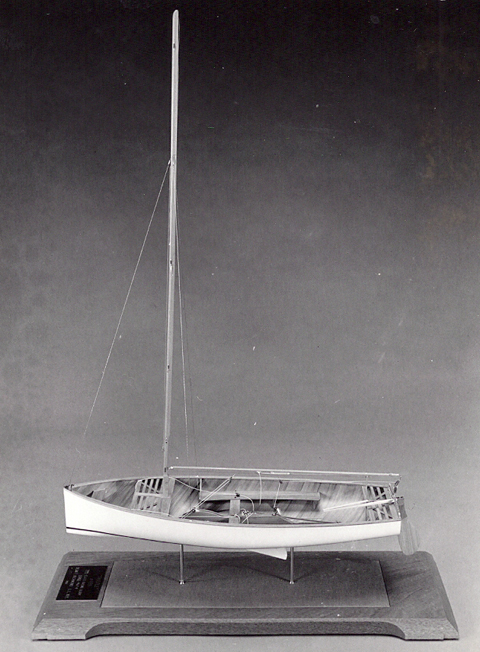
NOTES: Although a model of a simple vessel, this is one of the finest modelmaking achievements in the collection. It closely follows the building techniques and materials of the actual boat; a distinctive opportunity in small-craft modeling, and both hull and fittings are superb in representing the crisp precision of modern boats. While it did not win an award in the 1980 Scale Ship Model Competition, this and one or two other small craft models led the judges to recommend establishment of a separate Small Craft Division in later competitions, so that such "perfect" models may be judged on their own rather than against much more complex models, such as large, wooden warships, that are in fact less-complete replicas of their originals. The modelmaker advises that the odd scale of 15/16"-1' (or 1:12.8 ratio) was unintentional, in that he worked from a print obtained from the boat's designer. The print was marked as 1"=1' (1:12) but had shrunk in the reproduction process. He did not realize this until he was well along in the construction, so he simply labeled the model to reflect its actual - if accidental - scale, rather than his intentions. INVENTORY: Case, rudder, paddles - there are three (3) component parts.
Report of Committee of Arrangements, and correspondence with the Royal Clyde Yacht Club and James Bell, esq. in relation to matches with the "Thistle" for the America Cup
Shows a skipjack moored in the water, a motorboat is moored to a pier close to shore. This shot is made in Smith's shipyard in Shad Point, Maryland. There is no caption for this negative.
NEW JERSEY, WEST HOBOKEN; RELATED PLACE: NEW YORK, LOWER BAY HARBOR
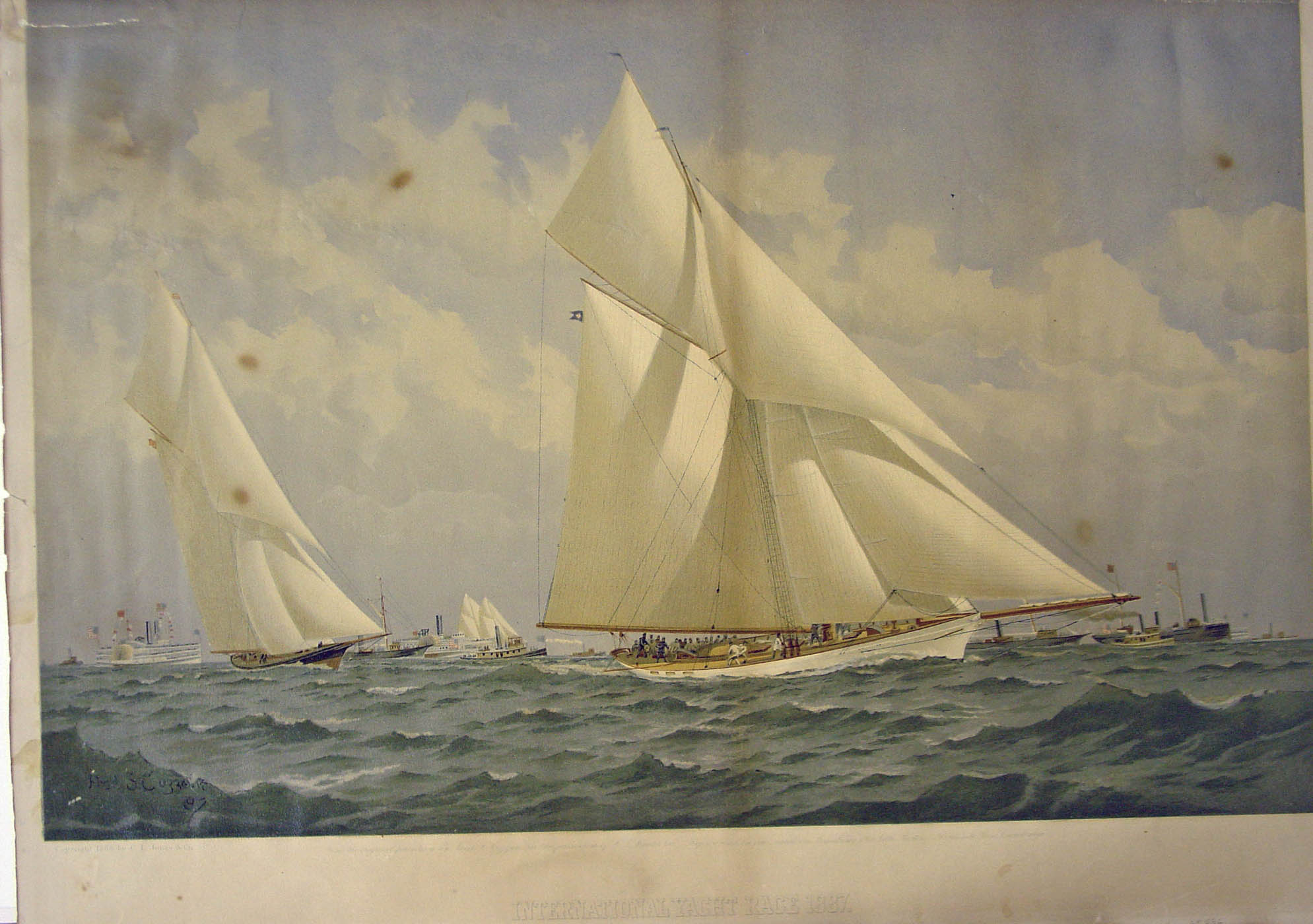
SHORT DESCRIPTION: Oil painting on canvas by Antonio Jacobsen showing Volunteer during a race, possibly the 1887 America's Cup race against Scottish challenger Thistle. The painting is signed and dated at the lower right. NOTES: The 1887 challenge for the America’s Cup was contentious from the beginning. -After James Bell’s initial challenge request was rebuffed by NYYC because it wasn’t submitted in the “proper form,” his syndicate at the Royal Clyde Yacht Club decided they would play the game in the manner set by the NYYC and gave Scottish designer George L. Watson carte blanche to build the fastest yacht possible. -In what would become recurring events in America’s Cup history their challenge boat, Thistle, was built in absolute secrecy. The boat was draped in tarpaulins until she hit the water. The RCYC also waited until March to send their formal challenge which gave the NYYC the minimum required information and little time to build a defender. -Undaunted, General Charles Paine (who’d been successful in the previous two challenges) picked up the gauntlet and had Edward Burgess design the centerboard compromise sloop Volunteer. -She was built by Pusey & Jones in Wilmington, Delaware in a remarkably short 66 days. -She was the first America's Cup yacht built with an all steel frame and hull. Her deck was made of white pine. -Baffled by the secrecy surrounding the build of Thistle, when she docked in New York a newspaper hired a diver to go down one night to explore the mysteries of her bottom. -When the boats were officially measured it was discovered that Thistle was 45cm over her declared length which caused an uproar and George Schuyler (the last of the Cup’s donors) had to step in and agree to let Thistle race (albeit penalised on handicap). -Volunteer won both races. The first by over 19 minutes and the second by nearly 12. VESSEL INFORMATION - VESSEL NAME: VOLUNTEER SHIPBUILDER: PUSEY & JONES BUILDER LOCATION: WILMINGTON, DELAWARE SHIP DESIGNER: EDWARD BURGESS VESSEL LAUNCHED: JANUARY 1887 SHIP OWNERS: GENERAL CHARLES J. PAINE, NYYC VESSEL DIMENSIONS: 85' LWL X 106'3" LOA X 23'2" BEAM X 10' DRAFT VESSEL HISTORY: Raced against THISTLE in the 1887 America's Cup Series.
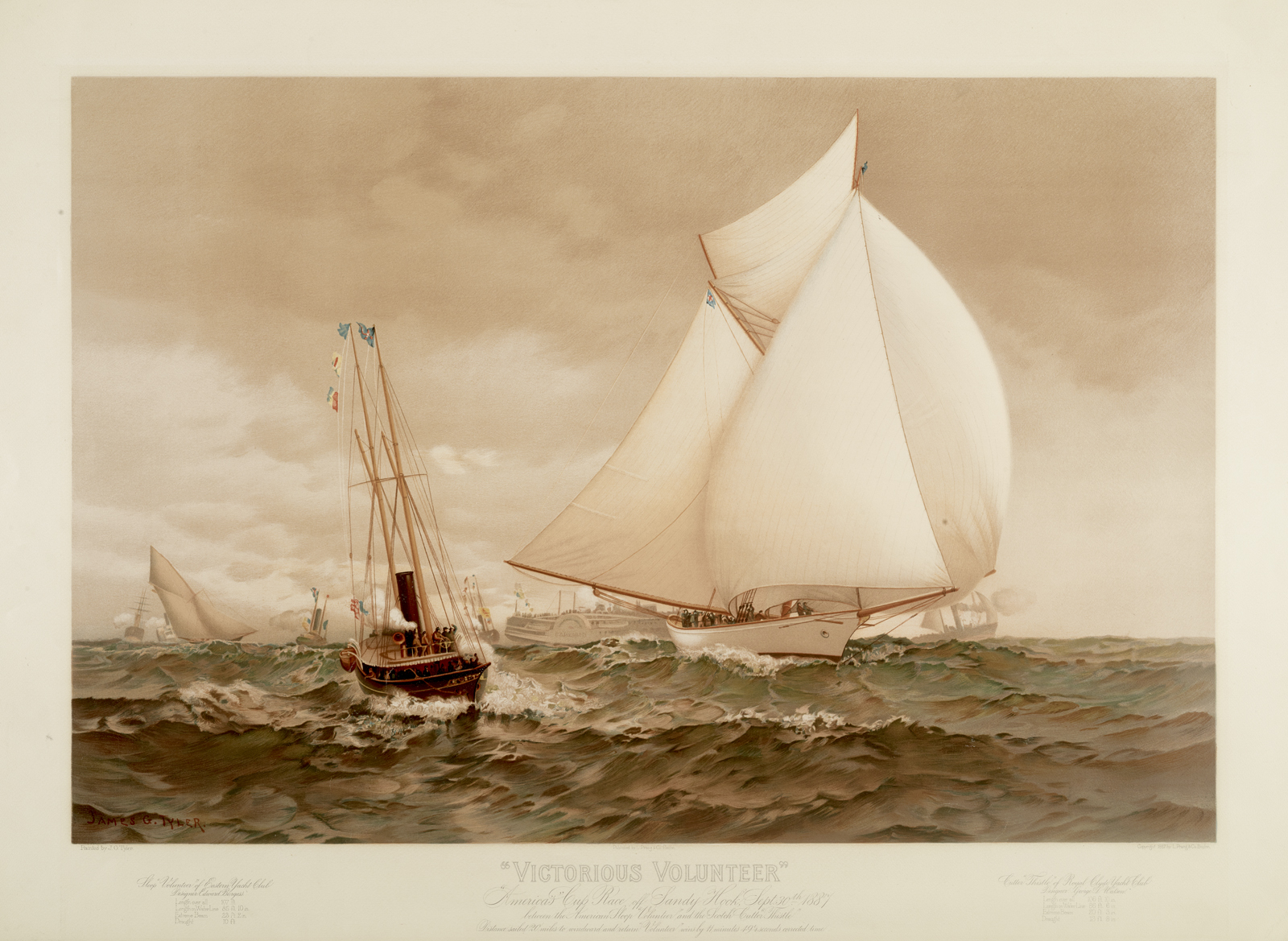
SHORT DESCRIPTION: Process print in colors (Collotype). ADDITIONAL INFORMATION: See Yachting, April-May, 1936, "The Fate of the Cup Defenders", by William U. Swan, p. 46.
SHORT DESCRIPTION: Copper token. The obverse features a starboard broadside view of a three masted ship with sails furled with the legend "Payable at the store of J. Brown". The reverse has an image of a four-leaved thistle with the legend "Nemo Me Impune. Lacessit." There is a hole drilled through the word "Brown" and "Nemo". NOTES: The has been described as a Scottish conder token and a trade token from Nova Scotia. NOTES: "Nemo me impune lacessit" is the Latin motto of the Order of the Thistle and of three Scottish regiments of the British Army. It is often translated as "No one attacks me with impunity" or alternatively translated into English as "No one can harm me unpunished".
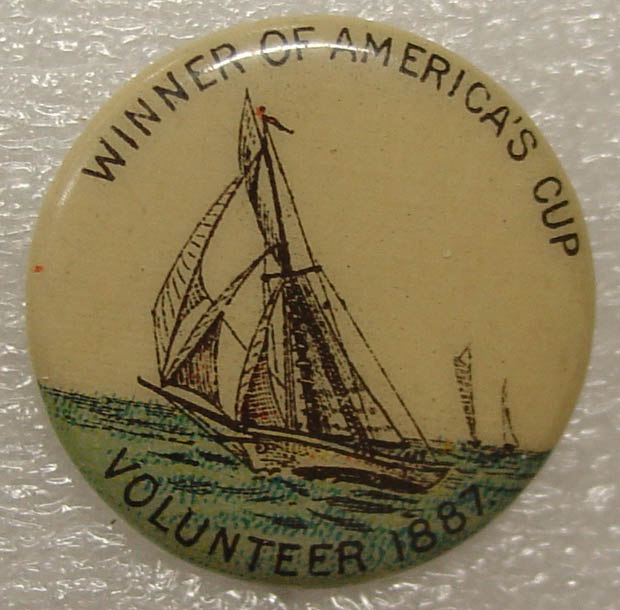
SHORT DESCRIPTION: Celluloid button on pin. Port bow view of the sloop VOLUNTEER. VESSEL INFORMATION - VESSEL NAME: VOLUNTEER SHIPBUILDER: PUSEY & JONES BUILDER LOCATION: WILMINGTON, DELAWARE SHIP DESIGNER: EDWARD BURGESS VESSEL LAUNCHED: JANUARY 1887 SHIP OWNERS: GENERAL CHARLES J. PAINE, NYYC VESSEL DIMENSIONS: 85' LWL X 106'3" LOA X 23'2" BEAM X 10' DRAFT VESSEL HISTORY: Raced against THISTLE in the 1887 America's Cup Series.
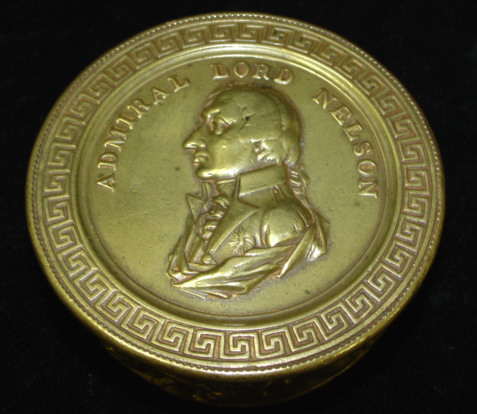
SHORT DESCRIPTION: Snuff box showing head and shoulders of Nelson in profile surrounded by a key design. There are symbols of Britain on the sides: thistle, clover, roses, etc. The remains of red paint are on the interior of the lid and base.
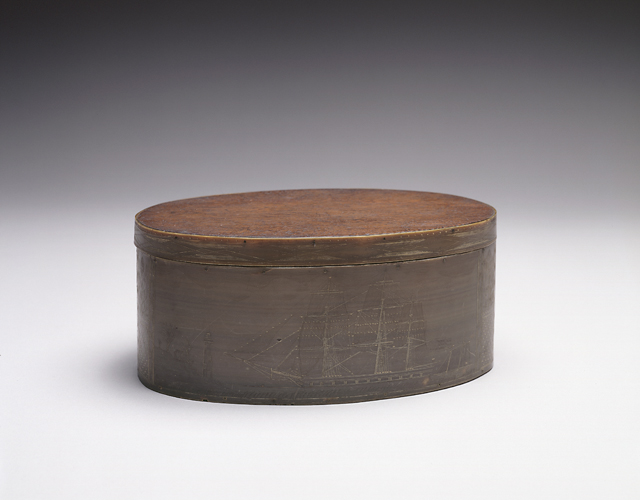
SHORT DESCRIPTION: Baleen trinket or ditty box, eliptical, softwood lid and bottom, strip around lid engraved with repeat geometric border design. Box sides engraved with port view of American naval or merchant ship, small schooner, and headland with lighthouse, home and trees. Two vignettes, show potted flowers, including a thistle. Vignettes separated by vertical bands of floral and geometric designs. Five "fingers" at box seam. Inner lip of box also has traces of floral and geometric designs. LABEL COPY: Ditty Box Pine and engraved baleen, mid-19th century Museum Collection 34.427 IS 136 INVENTORY: lid - there is one (1) component part.
NEW YORK - NEW YORK - UNITED STATES - Related Place
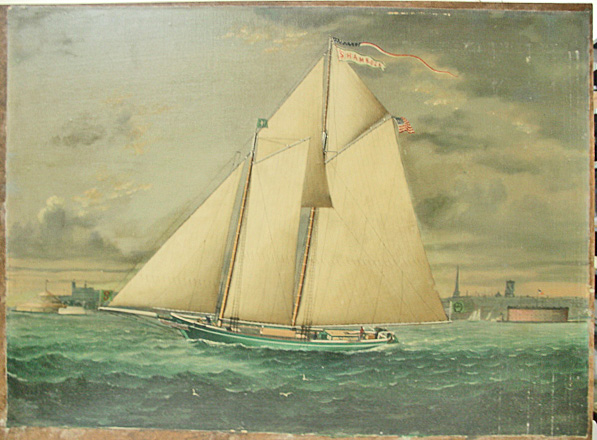
NOTES: The flag flying from the stern has a beige background with a three stemed thistle in the center surrounded by a wreath. There is a small green flag with a yellow cross (+) on the foremast and a green flag with a large red "S" at the bow. The schooner is carrying a pennant with Shamrock. The battery and Castle Garden can be seen in the background. VESSEL INFORMATION: BUILD DATE: June 1868 VESSEL DATES: 1868-1905 SHIPOWNER: G.S. Wood & O (1868-1884); P. I. Troy (1884-) BUILDER LOCATION: Tompkins Cove HAILING PORT: Haverstraw (1868-1884); New York (1884-) DIMENSIONS: 76' length x 25.4 breadth x 5.10 draft
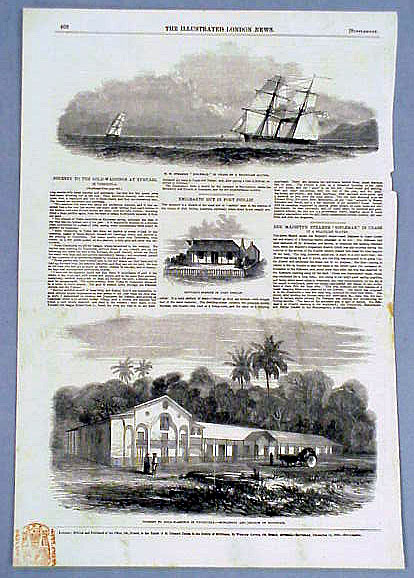
SHORT DESCRIPTION: Object is a newspaper document, page removed from original newspaper. At the top of the page is an image of two ships, The HM steamer RIFLEMAN chasing a Brazilian slave ship, presumably the ESMERALDA. The article accompanying this image appears in the right column of the page. In the left column is an article about a journey to Venezuela and an image of a monastery and church is found at the bottom of the page. In the center of the page is an article about an "Emigrant's hut in Port Phillip", with a small image in the center of the article. This page includes a red inked stamp that appears to essentially be price markings. This stamp has an illustration, which is that of a crown above threee images, including thistle, a flower, and a clover. The reverse of the page appears to be a listing of classified advertisements, mainly for books.
ENGLAND, LONDON; RELATED PLACES: AFRICA; HAITI; CANADA, MONTREAL; BELGIUM, OSTEND
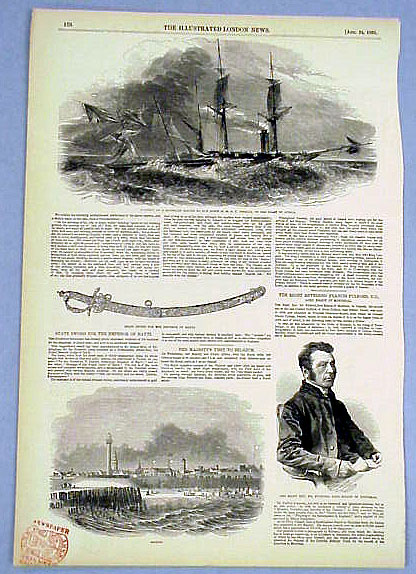
SHORT DESCRIPTION: Object is newspaper document, page removed from original newspaper. Under the Newspaper title is an image of a Brazilian slaver attempting to run down the HMS V PPHOENIX off the coast of Africa. An article about the event follows. Below this is and image of a state sword from the emperor of Haiti, with an article about it underneath and a small piece about the queen's visit to Belgium. At the bottom right of the page is an image of Ostend, Belgium. Along the right side, from the center to the bottom is an article about the Right Reverend Francis Fulford, D.D., Lord Bishop of Montreal, with an image of the man. On the bottom left corner is a red inked stamp that appears to essentially be a price marking. There is an illustration in the stamp, which is that of a crown above three images, including thistle, a flower, and a clover. On the back of the page is a listing of the county news, an article about "THE ARET OF SUCCESSFUL EMIGRATION", news of happenings in Ireland, and a listing of different news stories concerning world events.
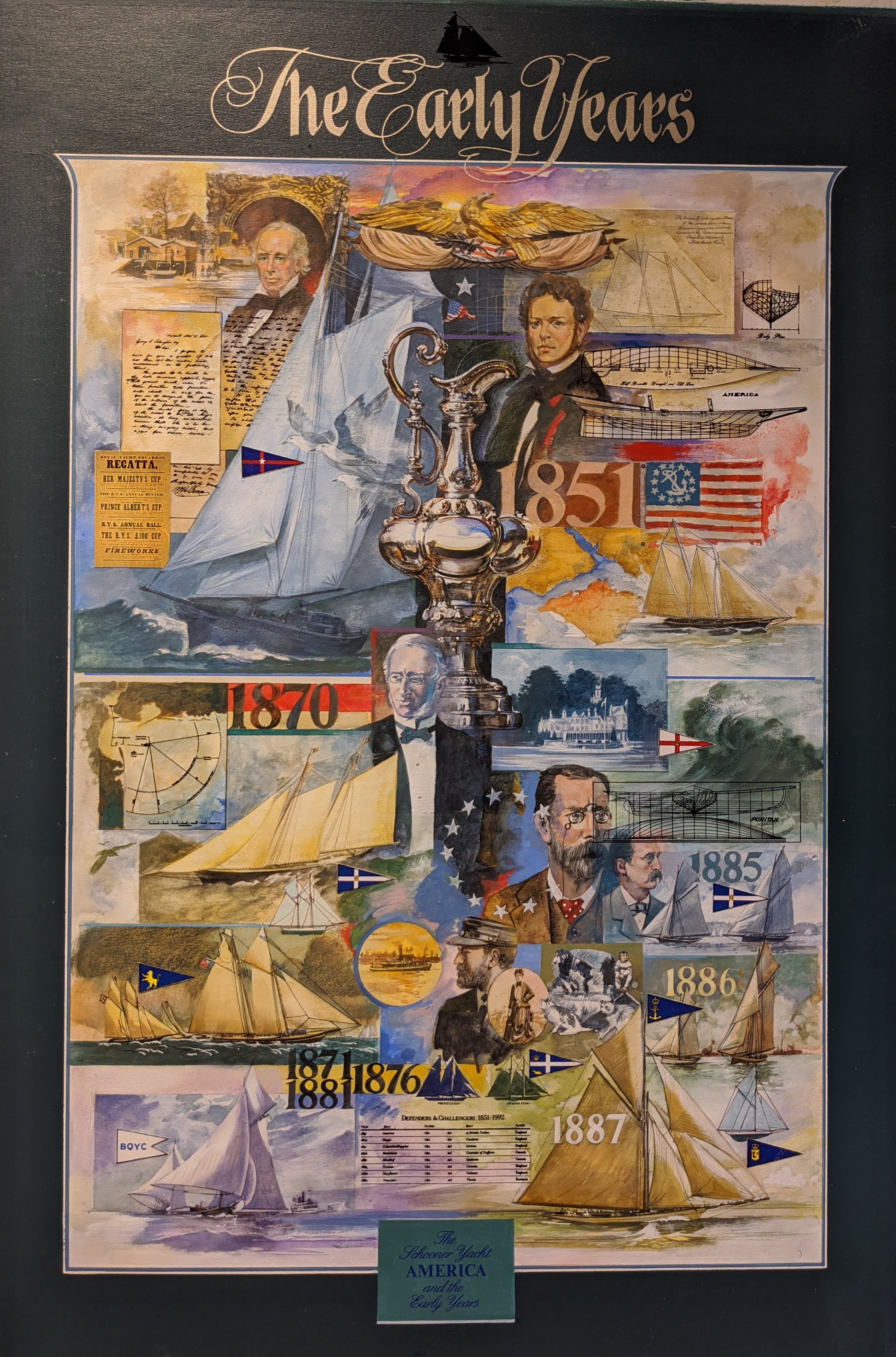
SHORT DESCRIPTION: Mixed media painting (acrylic, watercolor, oil). The image is a complex collage of images related to the America’s Cup from 1851 to 1887 created by artist Werner Claussen. The top half of the image documents scenes related to the 1851 race and the bottom half includes scenes from the 1870 to 1887 races. At the center is the America's Cup trophy. NOTES: The artwork was commissioned by the donor who intended to produce a limited edition print or poster. Werner Claussen was born in Germany and taught at the Center for Creative Studies (CCS) and the College for Creative Studies in Detroit. He worked as a commercial artist for decades, and enjoyed many commissions from the automobile industry (he created a historical montage of Ford Motor Company’s racing history) and the Ford family. Accompanying the artwork is a black and white produced by Claussen as a comprehensive layout before completing the final work. Clients typically spent $6000 for a work of this size and complexity and Claussen wanted to ensure there were no surprises at any stage. The differences in the final art from the photostat are refinements based upon Claussen’s judgment of the composition of the elements and on his own research as the work unfolded. Clients typically provided research for the elements included in one of Claussen’s complex historical artworks, but they usually did not interfere with the artist’s composition as he was considered a “master of composition.” NOTES: Scenes depict the following races: 1851: The yacht America defeats the fifteen vessels belonging to the Royal Yacht Squadron in a race around the Isle of Wight. 1870 (1st): The New York Yacht Club’s Magic (owned by Franklin Osgood) defeats the Royal Thames Yacht Club’s Cambria (owned by James Ashbury). 1871 (2nd): The New York Yacht Club’s Columbia (owned by Franklin Osgood) and Sappho (owned by Co. W. P. Douglas) defeats the Royal Harwich Yacht Club’s Livonia (owned by James Ashbury). Columbia won the first and second, Livonia won the third race, and Sappho won the fourth and fifth races. 1876 (3rd): The New York Yacht Club’s Madeleine (owned by James S. Dickerson) defeats the Royal Canadian Yacht Club’s Countess of Dufferin (owned by Major Charles Gifford and syndicate). 1881 (4th): The New York Yacht Club’s Mischief (owned by Joseph Busk) defeats the Bay of Quinte Yacht Club’s (Canada) Atalanta (owned by Alexander Cuthbert). 1885 (5th): The New York Yacht Club’s Puritan (owned by J. Malcolm Forbes and General Charles J. Paine and syndicate) defeats the Royal Yacht Squadron’s Genesta (owned by Sir Richard Sutton). 1886 (6th): The New York Yacht Club’s Mayflower (owned by General Charles J. Paine) defeats the Royal Northern Yacht Club’s Galatea (owned by Lt. William Henn RN). Henn and his wife lived aboard Galatea and raced with several dogs, a lemur and a monkey named Peggy who was an active participant in the race. 1887 (7th): The New York Yacht Club’s Volunteer (owned by General Charles J. Paine) defeats the Royal Clyde Yacht Club’s Thistle (owned by James Bell and syndicate).
VESSEL INFORMATION - VESSEL NAME: RAINBOW SERVICE DATES: 1934-ca 1940 VESSEL NAME: GALATEA SERVICE DATES: 1885- ca 1912 VESSEL NAME: SHAMROCK II SERVICE DATES: 1901 - ca. 1910 VESSEL NAME: SHAMROCK IV SERVICE DATES: 1914 - ca. 1924
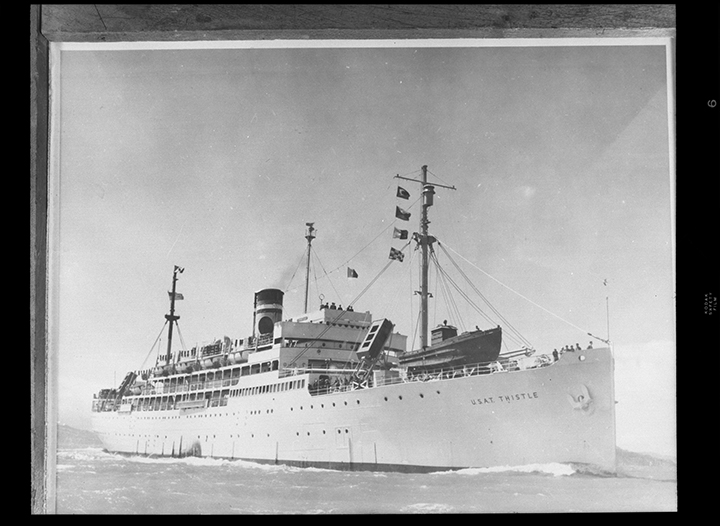
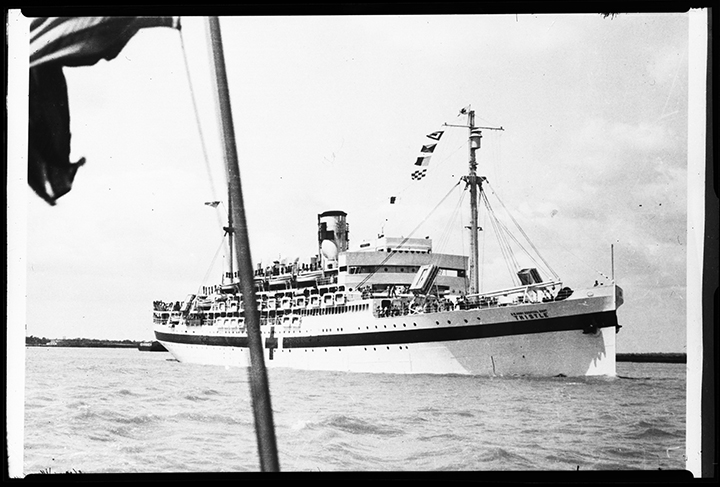
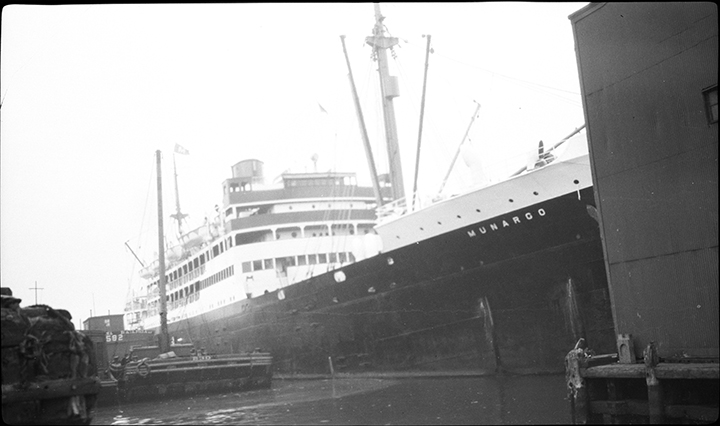
Munargo Line Company (United Fruit Subsidiary) (First Trip under new owners and House-Flag April 30, 1938 MUNARGO 1921 Munargo Line Company Side View of Ship tied Up at Pier "Munargo" 1921 USHS "Thistle"
VILLE DE PARIS (SHIP-OF-THE-LINE: 1764-1782); HMS PRINCE WILLIAM (SHIP-OF-THE-LINE: 1780-1817); ARDENT (SHIP-OF-THE-LINE: 1782-1784)
ILES DES SAINTES - WEST INDIES - Related Place
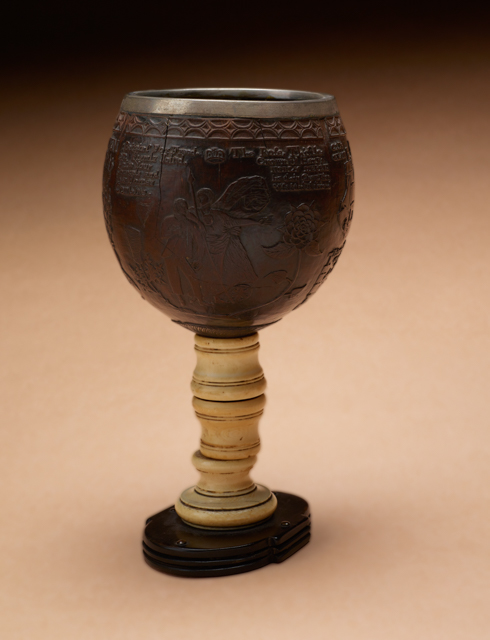
SHORT DESCRIPTION: Goblet made of a coconut depicts the Battle of Saintes. Goblet is made of a coconut shell and has a sterling silver rim. The stem of the goblet is made up of three spindles of ivory, the top two appear to be hippo ivory (concentric ovals in the ivory are unique to this animal) and the lowest spindle is elephant ivory- as indicated by the cross hatched diamond pattern. The base is made of a dark wood. The coconut shell is covered with carvings of five ships identified as "C De Grass in Ville De Paris struck to Sir Saml. HOOD 12th apl 82," "Prince Wm. in Chace of an other SHIP," "Ardent Struck to the Pr. Wm.", three plants identified as "STACHYS" "ORIGANUM' "ORCHI_", and two figures, one male and the other female. The female appears to be St. Catherine (as indicated by her symbol, the Catherine Wheel at her feet). However, it is more likely Britannia, considering the subject matter. Around the woman's neck hangs a mask. The goblet bears the inscriptions: "Britain For Freedom Firmly Joind, Unite Your Councels and Your Forces Combine, The Rose, Thistle, Crown & Harp, Nobly Defend be their Champion & faithful friend." NOTES: [John A. Tilley, November 12, 1981] The Battle of the Saintes was one of the major events of the War of American Independence. The goblet, while its provenance is unknown, almost certainly was made in England or one of the West Indian islands shortly after the event as a souvenir. NOTES: The Battle of the Saintes was the last major naval action between the French and English in the American Revolutionary War. It was fought between April 9 and 12th 1782 near the Iles des Saintes as small group of islets just north of Dominica in the West Indies. Admiral Sir George Rodney's victory over the French fleet of the Comte de Grasse foiled the latter's attempt to invade Jamaica and enabled Britain to secure its position in the West Indies even though she lost her American colonies. The battle is famous as the point of origin of the tactic of 'breaking the line', which was achieved with great, albeit accidental, effect by Rodney in seizing an advantage created by a shift of wind as the fleets began the action. See the attached file for a description of the April 9-12, 1782 battle by Alfred Thayer Mahan.
WILMINGTON - DELAWARE - UNITED STATES - Manufacturer; BOSTON - MASSACHUSETTS - UNITED STATES - Related Place
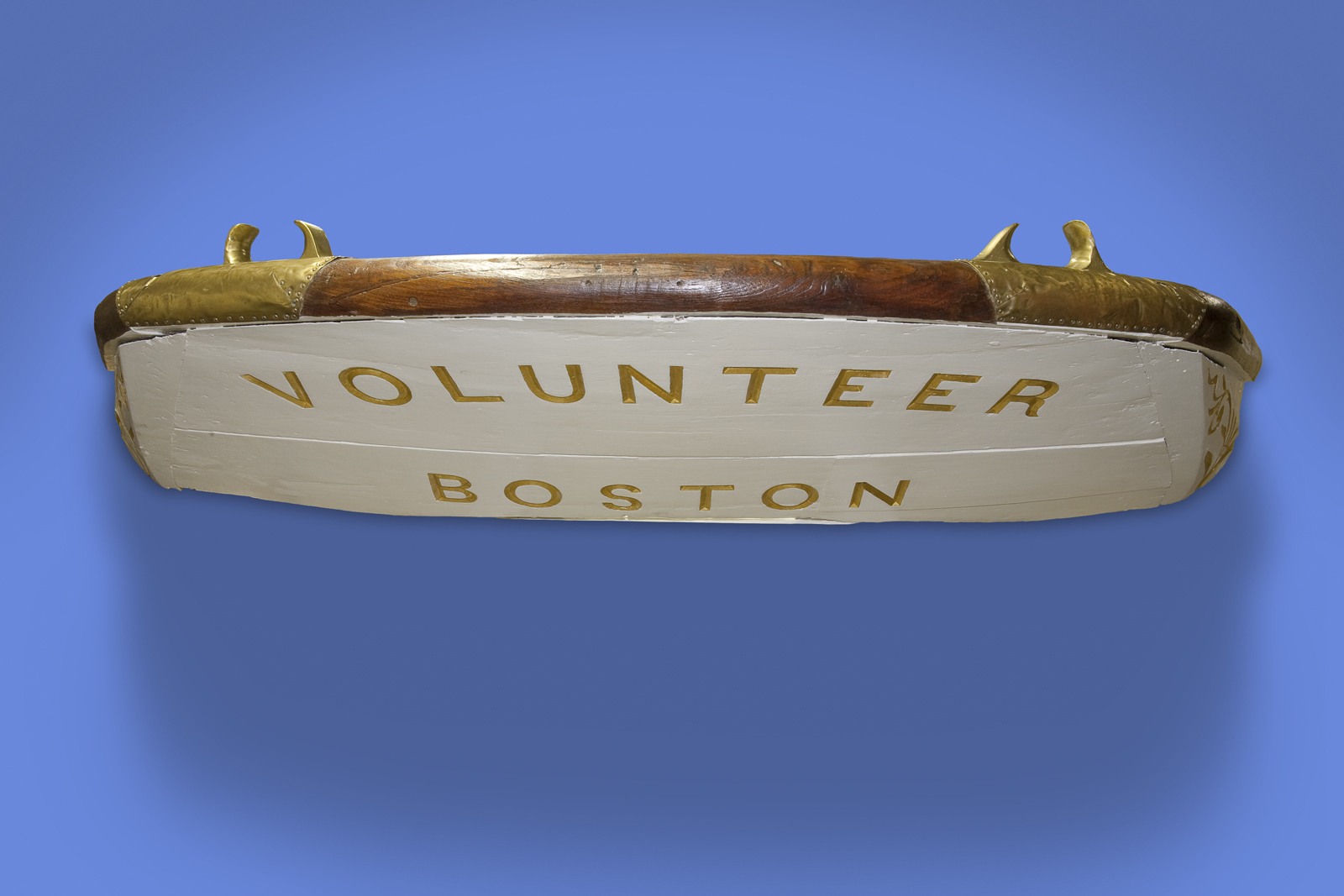
SHORT DESCRIPTION: Transom from the yacht VOLUNTEER. Only the upper part of the transom is preserved. The pieces include: the aft rail, quarter knees, four transom frames (port, starboard, and two inner frames), and two small portions of hull plank. The aft rail has two stern chocks and which have brass chafe pads. NOTES: The donor obtained this piece when the vessel was being demolished for scrap metal at Staten Island. At this time he had a couple of men saw the section off and ship it to his home, where it remained in his basement for approximately 30 years. He suggests that "the application of sufficient paint and putty, with perhaps a bit of gold leaf in the letters and scroll, will return it to its original splendor." It was donated with the condition that it "be thus refinished and placed on display". ADDITIONAL INFORMATION: Harper's Weekly, July 16, 1887, pg. 506; June 30, 1887, pp. 543-544; September 24, 1887, pp. 681 & 684; October 8, 1887, pp. 725, 728 & 729 Yacht Register, 1889 Newton, "The Blue Ribbon of the Sea", pp. 12 & 161 Yachting, April, May, 1936 Swan, "The fate of the Cup Defenders" Part 2, May 1936, pg. 46 VESSEL INFORMATION - VESSEL NAME: VOLUNTEER VESSEL TYPE: Sloop; Yacht SERVICE DATES: 1887-1910 SHIP BUILDER: Pusey & Jones BUILDER LOCATION: Delaware, Wilmington VESSEL HISTORY: Volunteer was a centerboard compromise sloop designed by Edward Burgess and built by Pusey & Jones Shipbuilding Company at Wilmington, Delaware in 1887 for owner General Charles J. Paine of the New York Yacht Club. Volunteer was the first America's Cup yacht with an all steel frame and hull. Her deck was made of white pine. Volunteer easily beat the 1886 America's Cup defender Mayflower during the defender trials for the 1887 America's Cup and won both Cup races on September 27 and 30, 1887, against Scottish challenger Thistle. Volunteer was skippered by Captain Hank Haff with the assistance of Captains Terry, Berry and L. Jeffreys. Soon after the Cup races, Volunteer was bought by John Malcolm Forbes (who also owned Puritan) and was altered as a schooner by George Lawley & Son, Corp. in 1891. Again altered from schooner to cutter 1894. It was broken up at a New York junkyard in 1910. MAJOR EVENT: Seventh America's Cup
Virginia–Maps–Early works to 1800.; Maryland–Maps–Early works to 1800.
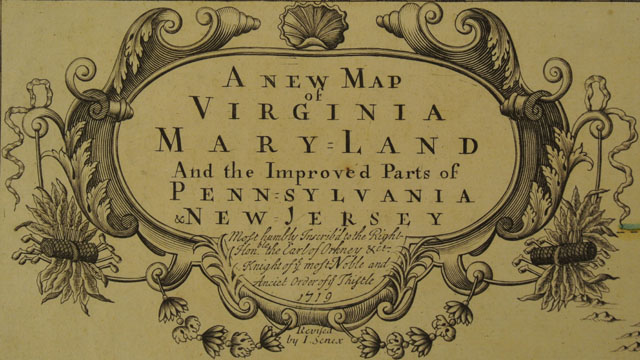
"Most humbly Inscrib'd to the Right Hon.ble the Earl of Orkney &ct. Knight of ye most Noble and Anciet Order of ye Thistle 1719"; "Revised by I. Senex"
copied from Herman Moll's map; shows northern Virginia and Maryland coast, and parts of Pennsylvania and New Jersey. Senex changed the imprint on the 1685 Browne plate to make this map for his atlas. Dedicated to the Earl of Orkney, Lord George Hamilton, absentee governor of Virginia from 1710 to 1737. Morrison, On the Map, Fig. 24, p. 37.
HMS ROYAL GEORGE (SHIP-OF-THE-LINE: 1756-1782); HMS DILIGENTE (SHIP-OF-THE-LINE: 1780-1784); HMS ROYAL WILLIAM (SHIP-OF-THE-LINE: 1692-1813)
LONDON - ENGLAND - Publisher
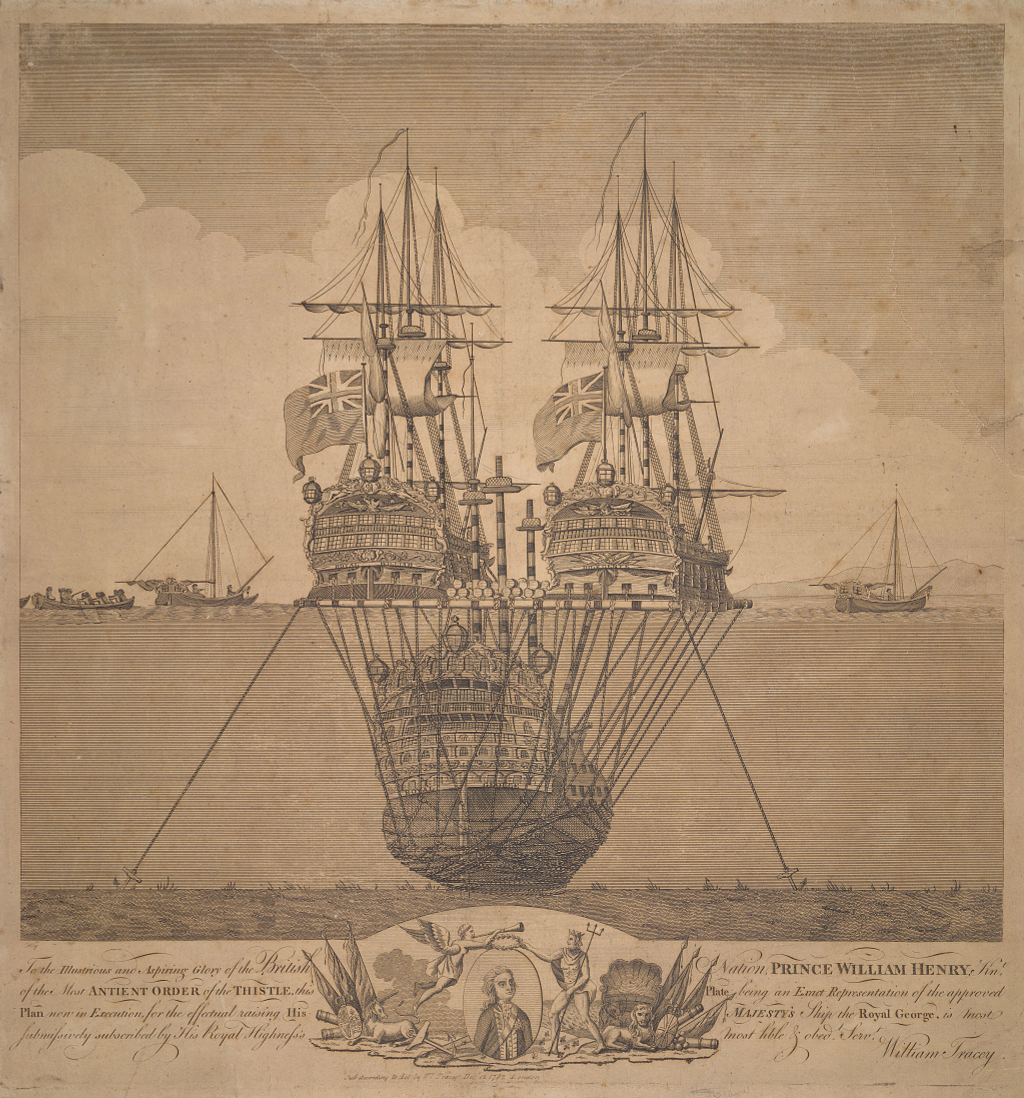
SHORT DESCRIPTION: Engraving showing the HMS Royal William and HMS Diligente attempting to raise the HMS Royal George from the bottom of the Solent. Engraved or drawn by Colley and published by William Tracey on December 12, 1782. The image shows the sterns of the Royal William and Diligente (spelled Dilegente) with the masts of the Royal George between them. Long stages run across the bows and sterns of two vessels. A number of cables run from the stages, stern ports and gun ports of the two ships and are secured around and underneath the hull of Royal George. From the ends of the stern stage mooring cables anchor the ships. NOTES: [Text from Royal Museums Greenwich] The first-rate ship HMS Royal George was laid down as the Royal Anne but renamed in honour of the reigning monarch George II before her launch in 1756. The first warship to exceed 2,000 tons burden, Royal George was commissioned at the start of the Seven Years' War with France and joined the Western Squadron in blockading the port of Brest and Quiberon Bay. On 29 August 1782 whilst undergoing minor repair work at Spithead, the Royal George began to take on water. She capsized and sank very quickly with the loss of about 900 lives. The dead included Rear-Admiral Richard Kempenfelt and as many as 300 women and 60 children who were visiting the ship at the time, prior to their husbands and fathers departing Britain’s shores. It was reported that all of the children but one lost their lives; a single little boy surviving by clinging on to a sheep which had been on-board. The exact cause of the disaster is not known although it has been suggested that she was heeled too far and the water entered the lower tier of gunports. However, a subsequent court-martial acquitted the ship's officers and crew (most of whom were dead) of any wrongdoing, and blamed the accident on the 'general state of decay of her timbers'. This reflected badly on the Navy Board, who were responsible for the ship’s condition and suitability for use. One hundred and seventeen proposals for recovering the vessel were sent to the Lords of the Admiralty, and eventually they settled on one from a Portsea shipbroker called William Tracey. The plan involved securing the ship by means of various ropes and slings, and attaching it to a raft which would be buoyed up by empty barrels. The idea was that as the tide rose, the ship would rise with it. However, the Portsmouth Dockyard authorities and the Navy Board were unhelpful (perhaps worried at what evidence would be uncovered) and poor weather impeded the plan, which was eventually abandoned. The Royal George had, however, been moved 30 feet across the seabed. In 1834, the pioneering diver John Deane recovered 30 guns before his work was interrupted to investigate a nearby wreck that turned out to be Mary Rose. The remains of Royal George continued to pose a risk to ships passing through Portsmouth harbour until in 1839 Colonel Charles William Pasley successfully implemented the explosion of the remains. NOTES: William Tracey was a diver and broker at Portsea, Hampshire who attempted to salvage HMS Royal George in 1782-1783. The "diving jacket" developed by Matthew Cox consisted of a suit with a copper headpiece fitted with a thick piece of glass in front of the diver's face. Two tubes of waterproofed leather were attached to the headpiece. One was attached to a hand bellows that was worked constantly to provide fresh air and the other allowed stale air to escape and sounds to be heard. The diver's body was also encased in copper with waterproof leather sleeves attached to the armholes that ended in "bags of oilskin, large enough to allow the hands and fingers full play'. There were also waterproof leather trousers with shoes attached. The shoes had enough lead attached to allow the entire suit to sink. The joints and seams of the suit were watertight.
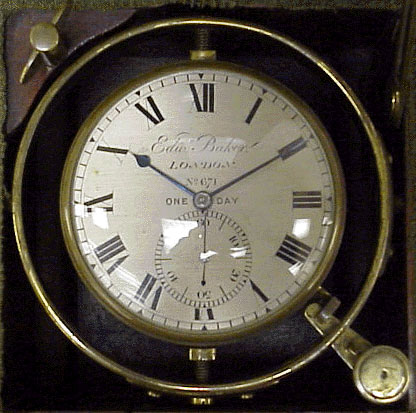
SHORT DESCRIPTION: One day marine chronometer, No. 671, made or retailed by Edward Baker. [Jonathan Betts, 2002] BOX/MOUNTING: Plain, three tier, mahogany box, 15.3cms high, 17.0cms wide and 15.5cms deep, with inlaid, brass, shaped lozenge escutcheon on front, and with a circular ivory plaque on front of upper half engraved: "ONE DAY / Baker / 671" the center of the disc having a turned sink where the British government's 'broad arrow', the symbol of government property, has been removed after sale from the Royal Navy. The box has standard fittings, with brass drop handles to sides and lacquered brass gimbals of standard layout except the winding key, which is positioned at the rear left of the box in a wooden corner shelf. The rising ratchet winding key is stamped: "2459" on both sides of the winged handle. The bezel is of narrow, ¼ round-section with a high domed, convex glass without site ring, the brass bowl with a revolving shutter for the winding square. The lower half and the upper half of the box have neat narrow scratched moulding at the junctions. The lid has butt hinges and the upper half, originally intended to go right over and lie flat, now has a brass strut keeping it open at 90°. The junction of the box has a green baize covering on the lower half, forming a dust seal when closed. The bottom of the box is covered in green baize. DIAL & HANDS: The silvered brass dial is 82mmsi and has a thick rim, neatly sweated on with lead solder, providing a deep recess at the back for locating the pillar plate of the movement, a locating peg at '11 o'clock' and fixed in place with two screws. The dial/movement assembly locates in the brass bowl with a pin in the edge of the dial at 12 o'clock. The dial has plain roman numerals and a seconds dial above VI with arabic ten-second figures with engraved batons at alternate five second intervals. The upper centre of the dial is signed: "Edwd Baker / LONDON / No.671. / ONE DAY" and the underside of the dial is scratched "5" and "671" and is punched with five rounded marks in a group, probably a batch mark. Polished and blued steel spade and poker hands with a fine pointer seconds hand with counter poised tail and a slotted, domed steel centre. MOVEMENT: Typical Earnshaw-type, one-day full plate fusee movement with four turned pillars, all fixed with screws, three with deep conical brass washers, the fourth using the barrel bridge as a separator. The general level of finish, which appears entirely original, is reasonably highly polished. The potence plate has a circular turned sink next to the balance where the governments 'broad arrow' was originally engraved. The underside of the pillar plate has five round dots, presumably a batch mark near to the edge of the plate, as do the potence, the barrel bridge, the third/fourth/escape wheel bar, the great wheel and the brass maintaining power wheel. The fusee lower pivot bar now has four dots but a fifth was probably erased when the pivot hole was bushed. The pillar plate is also scratched: "3"on the underside, as is the bottom of the barrel, and the barrel bridge is scratched: "CARTER BOWLES / 44" on the underside. The fusee has a fitted pipe around the square and Harrison's maintaining power. The blued steel mainspring set up, with click and return spring, is mounted on the barrel bridge. The barrel has had its original square hooking hole plugged and a steel hook riveted in alongside. The blued steel mainspring has been re-hooked, probably losing an original signature. Conventional four-wheel train plus great wheel, all wheels above the pillar plate but run on bars fixed behind. The train pivots have all been bushed during construction. There is a viewing hole in the bar next to the third wheel for checking the meshing of the center/third engagement, and an observation hole in the potence plate for checking the depth of locking of the detent. There are two small pointed pins set in the potence plate projecting up by about 1.5mm, the purpose of which is unclear but which might be guides for balance wedges when securing the balance during transit. ESCAPEMENT, BALANCE & SPRING AND JEWELLING: Typical Earnshaw spring detent escapement with a grey finished foot detent having a gold passing spring and a pink jewelled locking stone, with a brass banking piece alongside. The impulse roller has the typical raked, pink impulse stone and the discharge roller also has a pink discharging stone. The typical, two-arm Earnshaw-type bimetallic balance has tapered steel arms, and have original, brass mean time screws at the end, with an additional brass screw alongside each. The bimetal rims extend approximately 100° round from the arms and have segmental weights fixed with screws to the insides. The weights have sinks drilled in the undersides for poising. The blued steel helical balance spring has terminals on both ends, the upper terminal attached to a brass pointer stud. The jeweling extends to the balance and escape wheels, with endstones, the lower fourth hole and the escapement parts as mentioned. ALTERATIONS/CONDITION: The chronometer appears to be in substantially original state and the box is sound, though a little knocked and stained in places, with a crack across the front below the escutcheon and a crack and scratch damage on the back at the right. The brass furniture and the gimbals are somewhat tarnished with the lacquer breaking down in places, but all stable. The movement is generally in good sound working condition. The cross pin on the centre arbor holding the minute hand on has been broken off in the past and has been redrilled and shortened, the upper fusee pivot hole and the fusee ratchet wheel are quite badly worn, the great wheel teeth are now becoming quite hollow on the front surface and the movement parts generally show the polished and rounded surface wear of a number of cleans over the years. The balance spring is probably a later replacement and the strut to stop the upper half open at 90° is certainly a later addition, fitted anytime after about 1845. The mainspring has been rehooked and the balance cock foot has four burrs raised under the front edge, suggesting that a new balance staff has been made at some stage and that the fitter increased the endshake this way, rather than make the staff to fit correctly. PROVENANCE, ACQUISITION & NOTES: Baker 671: A life in Royal Navy service The Astronomer Royal's records and the Royal Observatory's ledgers of issues and receipts of chronometers to the Navy, record much of the working life of this chronometer. On 25 November 1823, the Astronomer Royal John Pond wrote informing the Commissioners at the Admiralty that two new chronometers by J.R.Arnold had both proved to be poor timekeepers on their arrival at Portsmouth, where they were urgently needed. Pond immediately provided two replacements, one being Baker No.671 which he says he "…was obliged to purchase on the occasion…" from Edward Baker. Baker escorted both down to Portsmouth by carriage, being paid six guineas for his time and the carriage, the price for No.671 itself being eighty guineas. Until decimalisation in 1971, British money was ordered in Pounds (£), Shillings (s) and pence (d). There are twelve pence in a shilling and twenty shillings in a pound and the figures were shown thus: £/s/d. So, for example "nine pounds two and six" would be: £9/2/6, and two shillings would be: 2/-. Until the 20th century, in Britain however, quality goods were usually sold in guineas. A guinea was £1/1/- (one pound, one shilling). Whether actually purchased in guineas or pounds however, monies in the account books were always shown in pounds shillings and pence. Thus the purchase of No.671 is shown in the Navy accounts as eighty four pounds (£84/-/-). It was directly as a result of the emergency purchase of Baker 671 that Pond recommended to the Commissioners that a small number of chronometers be kept on standby at the Royal Naval College at Portsmouth, their rates observed by the Professor there, in case a chronometer was suddenly needed in future. This scheme was then adopted at Portsmouth and also at the major naval base of Devonport, further west, along the coast at Plymouth. The officer in charge at the stores at Devonport was required to record the "weekly rate" (the mean daily rate averaged from the going on all of the seven days) of each chronometer, and, for a number of years, this was sent by post every Thursday to Greenwich for the Astronomer Royal's information. No.671's first employment was on His Majesty's Ship (HMS) ANTELOPE, Lieutenant Hire commanding, issued on 19 December 1823. This was something of a sad commission for a brand new chronometer, because the fifteen year old Antelope (1017 ton fourth rate) was crossing the Atlantic for the last time. Its final resting place, once stripped of all sails, was to be in the Government dockyard on Ireland Island, Bermuda, in the ignominious role of Prison Hulk, the first of four on those islands. Lieutenant Henry Hire stayed on Bermuda and remained in command of the convict ship for the next 20 years. Baker No.671 however, having navigated the Antelope safely across the Atlantic, was returned to Portsmouth Depot on 19 July 1824, from where it was sent to store at the Royal Naval College. 30 July 1824 it was issued to HMS DIAMOND (a fifth rate of 1,063 tons, built 1816), Capt Lord Napier, and returned in October 1826 to Porstmouth. During this period Diamond was stationed in South America, engaged in survey work for which Baker 671 would no doubt have been used. 14 January 1827 the chronometer was issued to HMS ARACHNE (a sloop of 386 tons built in 1809) consecutively commanded by William Robert Ashley Pettman, G.W.C. Courteney, H.Smith and Captain C.Deare, during which time the ship was serving in Jamaica. It returned on 10 July 1830 to Devonport, the officer in charge, H.C.Cox, reporting that it was found to be "..in a very dirty state..". After nine weeks of reporting the chronometer unfit for service, it was sent by sea with three others to Greenwich. On 2 November it was sent to Baker who submitted a condition report on the 5th, stating that it needed: "… new fourth wheel jewelled hole - the pivot being nearly cut through having been going so many years, Balance Spring, Box repaired & Glafs…". The report was supplemented four days later with an estimate from Baker of "Seven pounds Ten Shillings", annotated by Pond with: "Let the proposed repair be done". It was returned directly to Devonport on 3 March 1831. No.671 remained on standby at Devonport for the whole of the following year, Cox sending the weekly rates during that time. For the first three months the chronometer gently accelerated, beginning on 10 March at a mean weekly rate of +3.33 seconds per day, and climbing to a maximum of +4.70 by 9 June. Then it slowly but steadily deccelerated and by the end of the year its weekly rate was passing zero. By mid January it was -0.30 seconds per day, but by that time it seems there was a problem with the maintaining power, as the very next week its calculated weekly rate was -3.1 seconds and in his report of 26 January 1832, Cox pronounced the chronometer "unfit for service". He observed that "..the seconds hand appeared to reverse during winding…", remarking (with obvious lack of horological understanding!) that "…some part of the escapement has given way…". On 12 April it was returned along with four others, to Greenwich (via Woolwich) on board HM steam vessel Hermes. On 16 April it was sent on to Baker for repairs and returned to Greenwich on 22 May. The chronometer was then issued to HMS TRINCULO (a 23 year old sloop of 389 tons), Capt. James R. Booth, on 30 October 1832. Trinculo was stationed on the coast of Africa for three years, during which time Booth and his crew "…captured several slavers and performed many valuable services against the Caffres…". At an unknown date it was then passed on to HMS HARRIER (a sloop of 389 tons built in 1809) Commander Spencer L.H.Vassal, stationed in the East Indies "…where he was actively employed, particularly in the suppression of piracy in the straights of Malacca. After two severe conflicts he succeeded in destroying the settlements at Poulo Arroa and Poulo Sujee and to him may be acscribed the merit of having commenced a system of decided operations against the marauders…."(ref). From Harrier, it was returned to Greenwich on 7 November 1836. It appears that at this stage it was issued to HMS BEAGLE, the 235 ton surveying sloop, built in 1820, which had just returned from its epic six year odyssey with Charles Darwin and Captain Robert Fitzroy. The chronometer must have proved in need of attention as within a few days it had been sent to the makers, returning to the Observatory on 21 November. Once again it was sent back to Baker, presumably still proving troublesome, and returned to Greenwich on 20 March 1837. On May 27 1837 it was finally issued to HMS BEAGLE, now commanded by John C.Wickham, who had served as First Lieutenant with Fitroy and Darwin on the Beagles previous voyage. It returned to Greenwich for five days in June, probably for rating, finally leaving on the Beagle on June 8. This time, Beagle was employed in surveying the coast of Australia and Bass' Straight, the chronometer no doubt indispensible in determining longitudes. It was returned to Greenwich via Portsmouth on January 17, 1842. [See in TMMP library DU101 .S8 Rare Discoveries in Australia : with an account of the coasts and rivers explored and surveyed during the voyage of H.M.S. Beagle in the years 1837-38-39-40-41-42-43 ; also, a narrative of Captain Owen Stanley's visits to the islands in Arafåura Sea / by J. Lort Stokes] The following years of service, typical in the life of many Admiralty chronometers, demonstrate just how frequently a working instrument of this kind requires attention. No 671 was again sent to Baker for repairs on January 24, returning on February 14 and going directly to Plymouth again. After two years it returned and was sent to Baker for overhaul in the autumn of 1844. In early 1845 it transferred to Portsmouth for issue to HMS STYX (4 year old, 1,057 ton, paddle sloop) under Commander Henry Chads, serving on the coast of Africa, returning to Greenwich and going to Baker for overhaul in October 1849. Between April 1850 and October 1851 the chronometer was loaned to the Retired Navy Captain and celebrated arctic explorer Sir John Ross, for purpose unknown [SEE NOTE THAT FOLLOWS], after which it was again overhauled by Baker. Between January 1853 and November 1855 it journeyed between Portsmouth/Devonport, to Greenwich, to Baker and back, twice more. The second of these overhauls, in June 1855, was recorded as carried out by the new partnership of Baker & Frodsham, thereafter referred to as Frodsham and Baker (F&B). In February 1856 the chronometer was issued to HMS MEDINA (889 ton paddle steamer built in 1840), which was serving as a packet in the Mediterranean. It was returned to Portsmouth in the fall of 1857, was repaired by F&B and, in the following February, went to HMS RACOON (1,467 ton corvette) built that same year and also due to serve in the Mediterranean. It returned in January 1861, was repaired by F&B and was issued to one Commander Kennedy in May that year. Early in 1862 it was back and being overhauled by F&B, after which it spent two years at Devonport. October 1864 saw it go to "Mr G.E. Frodsham", now the partnership had ended, after which, in May 1865, it was issued to HMS TERRIBLE (a 20 year old,1847 ton paddle frigate, said to be the first 4-funnelled ship in the Royal Navy) also serving in the Mediterranean. The chronometer returned, via Portsmouth, in November 1865, to go to Frodsham again, then staying at Greenwich until it was sent to Devonport in November 1866. It was back at Greenwich again in October 1868 on its way to Frodsham for another overhaul, and in October 1869 it was issued to HMS THISTLE (465 ton Gun Vessel built the previous year) for the China station. No less than nine years later in May 1878, the chronometer returned via Deptford dockyard, and was naturally sent straight to G.E. Frodsham for overhaul. August 1879 saw it issued to HMS AUDACIOUS (3,774 ton battleship built in 1870) where it served as a guardship on the Humber, the ship then being refitted as Flagship on the China Station. The chronometer returned to Greenwich and on to Frodsham in the Spring of 1881 where it underwent repairs on two separate occasions, only being ready for service again in May 1882. In September that year it was sent to Devonport, and probably back out to China, returning four years later, in October 1886, from HMS VICTOR EMANUEL, a 3,087 second rate which had been serving as a receiving ship at Hong Kong. This time it was sent for repairs to J. Poole & Co. who now carried out much of the chronometer servicing for the Observatory. Baker 671 briefly returned to Greenwich in January 1887 but went back to Poole for more work in two months, then being sent to Portsmouth in the October. Over the following five years it travelled to Portsmouth and back to Poole's for servicing via Greenwich three times, and, after four years, returned from the Depot at Malta, probably having been in service in the Mediterranean fleet. In the following four years, between April 1896 and early 1900, the chronometer remained at Greenwich with no less than five visits to Poole's for servicing and adjustments. Then, on January 20 1900 it was issued to HMS SPEEDY (a six year old, 810 ton torpedo gunboat), serving in the Mediterranean. The chronometer returned from the Depot at Malta again in February 1902. After another visit to Poole's (at least the thirtieth time the chronometer had been overhauled in its life!), it was sent in March 1903 to Portsmouth, from where it returned, six years later, on February 19 1909. On August 15, over 75 years after it was first commissioned, it was sent to the famous chronometer manufacturers, E Dent & Co. This may have been for yet another overhaul, but it appears to have been deemed no longer fit for Royal Navy service, as it was taken in exchange for new instruments by Dents. The subsequent life of Baker 671 is not known. It may have continued to be used for marine navigation, as instruments taken in part exchange were often overhauled and readjusted and sold again to the merchant service as viable chronometers, and it may well have seen active service during the first and possibly even the second world wars, when chronometers were in short supply. The recent provenance of Baker 671 is that it came up for sale at Sotheby's London salerooms on 24 May, 2000. The chronometer was acquired for the museum from Charles Frodsham Ltd, London in January 2001. This is a first rate example of an early 19th century 'production' marine chronometer with a comprehensive and interesting Royal Navy history. NOTES: [Regarding use of chronometer by Sir John Ross] Ross made a third and final voyage into Arctic waters in 1850-51 when he went to the Lancaster Sound region to search for Sir John Franklin. Unable to get government backing he organized a private expedition aboard the 91-ton schooner Felix. The expedition spent the winter of 1850/51 in Barrow Strait, but the Felix was too ill-equipped to help very much in the search for Franklin. (The Felix had to rely on the other ships in the expedition for supplies.) From 'The Argus' (Melbourne, Vic. : 1848-1954) Monday 27 January 1851; RUMOURS OF SIR JOHN FRANKLIN. 'The Felix and eight other vessels, engaged in the search for Sir John Franklin, fell in with each 'other, by a happy coincidence, in Melville Bay on the 13th of August The weather was calm, mid the crews of the ships full of energy and hope. A consultation of officers took place, mid a common plan of investigation was agreed upon. On the day we have named, natives were discovered on the ice near to Cape York, and it was deemed advisable to enter into conversation with them. Two boats were detached for this purpose, and in one of them was the Esquimaux interpreter, whom Sir John Ross had carried with him from Holsteinburg, and who, in addition to the language, of the natives, has a knowledge of the Danish tongue. The Esquimaux entered freely into conversation with the interpreter, who appeared to understand and to be understood by them. Meanwhile, Sir John Ross was pushing forward in the Felix to Cape Dudley Diggs, und was far a-head. The boats, however, having rejoined the Prince Albert, the interpreter, anxious to disburthen himself, was dropped on board that vessel, and proceeded to tell the story he had heard from the natives to the Captain's steward, who possessed, according to Captain Phillips despatch, a "good," and according to Sir John Ross's a "little" knowledge of the Danish language. The story, as interpreted by the steward, was of the most deplorable character - that in the winter of 1846, when the snow was falling, two ships had been knocked to pieces by the ice near Cape Dudley Diggs; that the white men on board these ships wore epaulettes; that part of them were drowned, and part killed by the natives with darts or arrow's. The people on board the Prince Albert, startled by this intelligence, made all haste to overtake the other ships and on the l8th August, fell in with the Lady Franklin, commanded by Captain Penny, who had an interpreter with him of the name of Paterson. The Lady Franklin had touched at Cape York the day ? fore that on which the boats had had communication with the natives; but Mr. Paterson who had also conversed with the Esquimaux, had gathered no such tidings from them as had been disclosed by Sir John Ross's interpreter. Captain Penny, therefore, was disposed to disbelieve the whole story, and at once took steps to test its credibility. "I immediately offered my services," he says in his despatch," together with those of my interpreter and was happy to find that the sole foundation for the tidings was, that the North Star had wintered in the situation referred to "The information in reference to the North Star has been fully corroborated by the arrival of that vessel in this country. The North Star wintered in Wolstenholme last year. ADDITIONAL INFORMATION: See G620.S3 pages 319-323, Arctic explorations and discoveries during the nineteenth century : being detailed accounts of the several expeditions to the north seas, both English and American, conducted by Ross, Parry, Back, Franklin, M'Clure, and others, including the first Grinnell expedition, under Lieutenant De Haven, and the final effort in search of Sir John Franklin / edited and completed by Samuel M. Smucker. See the Illustrated London News, 1851 for an image titled 'North-West searching expedition for Sir John Franklin, Sir John Ross Yacht "Felix" at Anchor in Loch Ryan'. NOTES: Baker, while a watchmaker, was apparently not a full fledged maker of chronometers and many of the chronometers attributed to him appear to have a strong links indicating they are partly the work of Thomas Earnshaw and Thomas Earnshaw Junior. Finishing work, and possibly complete chronometers, were provided to Baker by John Frodsham (a former business partner).
THOMAS STREET - WOOLWICH - ENGLAND - Printer/Publisher
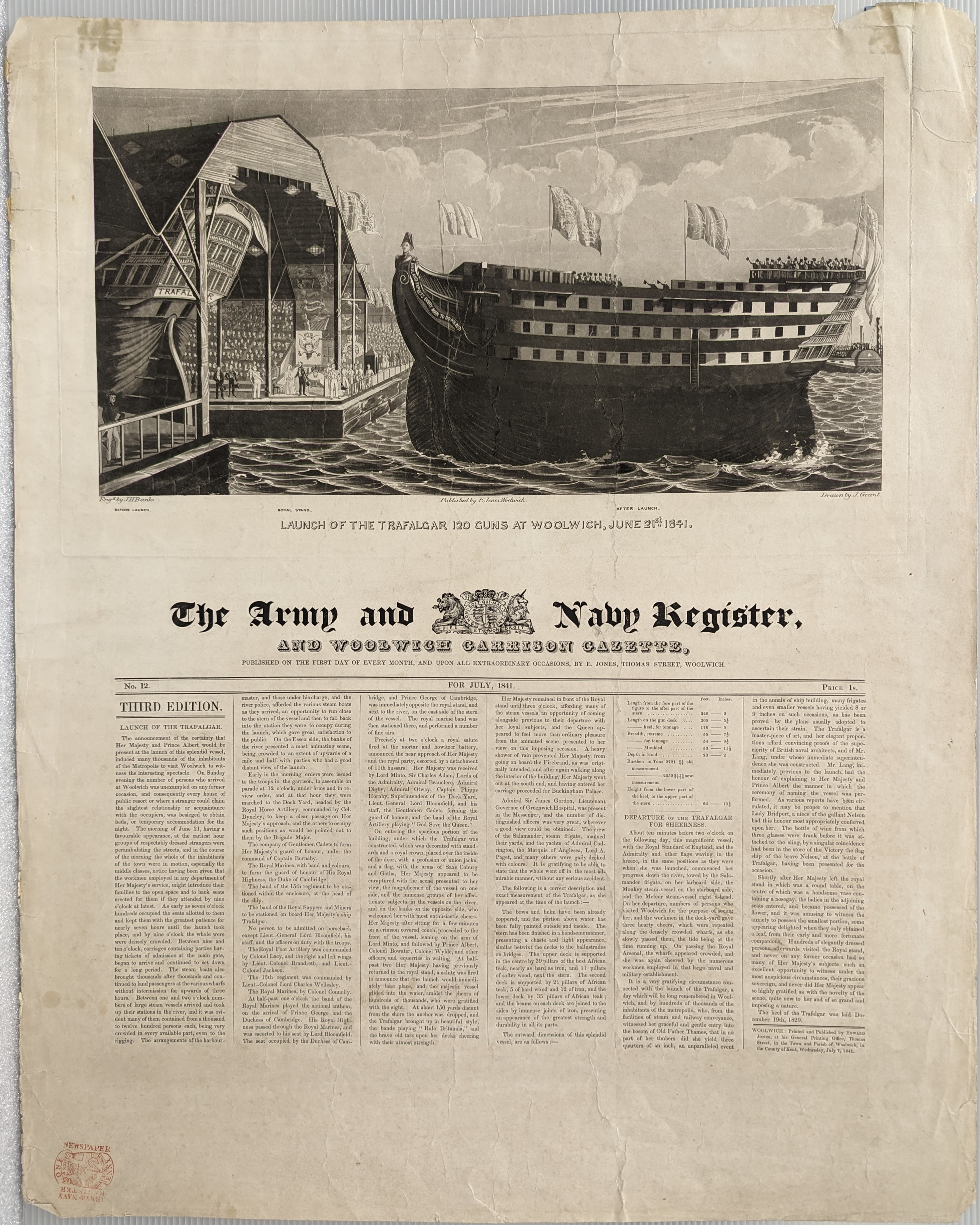
NOTES: Page from The Army and Navy Register, and Woolwich Garrison Gazette, published by Edward Jones, Thomas Street, Woolwich. This is issue number 12, for July 1841. TEXT: The Army and Navy Register, And Woolwich Garrison Gazette, Published on the First day of Every Monty, and Upon All Extraordinary Occasions, By E. Jones, Thomas Street, Woolwich, No. 12, For July, 1841. Price 1S., Third Edition. LAUNCH OF THE TRAFALGAR. [First column] The announcement of the certainty that Her Majesty and Prince Albert would be present at the launch of this splendid vessel, induced many thousands of the inhabitants of the Metropolis to visit Woolwich to witness the interesting spectacle. On Sunday evening the number of persons who arrived at Woolwich was unexampled on any former occasion, and consequently every house of public resort or where a stranger could claim the slightest relationship or acquaintance with the occupiers, was besieged to obtain beds, or temporary accommodation for the night. The morning of June 21, having a favourable appearance, at the earliest hour groups of respectably dressed strangers were perambulating the streets, and in the course of the morning the whole of the inhabitants of the town were in motion, especially the middle classes, notice having been given that the workmen employed in any department of Her Majesty's service, might introduce their families to the open space and to back seats erected for them if they attended by nine o'clock at latest. As early as seven o'clock hundreds occupied the seats allotted to them and kept them with the greatest patience for nearly seven hours until the launch took place, and by nine o'clock the whole were densely crowded. Between nine and ten o'clock, carriages containing parties having tickets of admission at the main gate, began to arrive and continued to set down for a long period. The steam boats also brought thousands after thousands and continued to land passengers at the various wharfs without intermission for upwards of three hours Between one and two o'clock numbers of large steam vessels arrived and took up their stations in the river, and it was evident many of them contained from a thousand to twelve hundred persons each, being very crowded in every available part, even to the rigging. The arrangements of the harbour- [Second column] master, and those under his charge, and the river police, afforded the various steam boats as they arrived, an opportunity to run close to the stern of the vessel and then to fall back into the station they were to occupy during the launch, which gave great satisfaction to the public. On the Essex side, the banks of the river presented a most animating scene, being crowded to an extent of upwards of a mile and half with parties who had a good distant view of the launch. Early in the morning orders were issued to the troops in the garrison, to assemble on parade at 12 o'clock, under arms and in review order, and at that hour they were: marched to the Dock Yard, headed by the Royal Horse Artillery, commanded by Col. Dyneley, to keep a clear passage on Her Majesty's approach, and the others to occupy such positions as would be pointed out to them by the Brigade Major. The company of Gentlemen Cadets to form Her Majesty's guard of honour, under the command of Captain Burnaby The Royal Marines, with band and colours, to form the guard of honour of His Royal Highness, the Duke of Cambridge. The band of the 15th regiment to be stationed within the enclosure, at the head of the ship. The band of the Royal Sappers and Miners to be stationed on board Her Majesty's ship Trafalgar. No person to be admitted on horseback except Lieut.-General Lord Bloomfield, his staff, and the officers on duty with the troops. The Royal Foot Artillery commanded by Colonel Lacy, and the right and left wings by Lieut.-Colonel Brandreth, and Lieut. Colonel Jackson. The 15th regiment was commanded by Lieut.-Colonel Lord Charles Wellesley. The Royal Marines, by Colonel Connolly. At half past one o'clock the band of the Royal Marines played the national anthem, on the arrival of Prince Gorge and the Duchess of Cambridge. His Royal Highness passed through the Royal Marines, and was escorted to his seat by Lord Bloomfield. The seat occupied by the Duchess of Cam- [Third column] bridge, and Prince George of Cambridge, was immediately opposite the royal stand, and next to the river, on the east side of the stern of the vessel. The royal marine band was then stationed there, and performed a number of fine airs. Precisely at two o'clock a royal salute fired at the mortar and howitzer battery, announced the near approach of Her Majesty and the royal party, escorted by a detachment of 11th hussars. Her Majesty was received by Lord Minto, Sir Charles Adam, Lords of the Admiralty, Admiral Beauclere, Admiral Digby, Admiral Otway, Captain Phipps Hornby, Superintendent of the Dock Yard, Lieut.- General Lord Bloomfield, and his staff, the Gentlemen Cadets forming the guard of honour, and the band of the Royal Artillery playing "God Save the Queen." On entering the spacious portion of the building, under which the Trafalgar was constructed, which was decorated with standards and a royal crown, placed over the inside of the door, with a profusion of union jacks, and a flag, with the arms of Saxe Coburg and Gotha, Her Majesty appeared to be enraptured with the scene presented to her view, the magnificence of the vessel on one side, and the immense groups of her affectionate subjects in the vessels on the river, and on the banks on the opposite side, who welcomed her with most enthusiastic cheers. Her Majesty after sitting for a few minutes on a crimson covered couch, proceeded to the front of the vessel, leaning on the arm of Lord Minto, and followed by Prince Albert, Colonel Bowater, Colonel Wylde, and other officers, and equerries in waiting. At half past two Her Majesty having previously returned to the royal stand, a salute was fired to announce that the launch would immediately take place, and the majestic vessel glided into the water, amidst the cheers of hundreds of thousands, who were gratified with the sight. At about 150 yards distant from the shore the anchor was dropped, and the Trafalgar brought up in beautiful style, the bands playing "Rule Britannia," and the brave old tars upon her decks cheering with their utmost strength. [Fourth column] Her Majesty remained in front of the Royal stand until three o'clock, affording many of the steam vessels an opportunity of coming alongside previous to their departure with her loyal subjects, and the Queen appeared to feel more than ordinary pleasure from the animated scene presented to her view on this imposing occasion. A heavy shower of rain prevented Her Majesty from going on board the Firebrand, as was originally intended, and after again walking along the interior of the building, Her Majesty went out at the south end, and having entered her carriage proceeded for Buckingham Palace. Admiral Sir James Gordon, Lieutenant Governor of Greenwich Hospital, was present in the Messenger, and the number of distinguished officers was very great, wherever a good view could be obtained. The crew of the Salamander, steam frigate, manned their yards, and the yachts of Admiral Codrington, the Marquis of Anglesea, Lord A. Paget, and many others were gaily decked with colours. It is gratifying to be able to state that the whole went off in the most admirable manner, without any serious accident. The following is a correct description and exact measurement of the Trafalgar, as she appeared at the time of the launch:- The bows and helm have been already coppered, and the portion above water has been fully painted outside and inside. The stern has been finished in a handsome manner, presenting a chaste and light appearance, similar betwixt the decks to the ballustrades on bridges. The upper deck is supported in the centre by 39 pillars of the best African teak, nearly as hard as iron, and 11 pillars of softer wood, next the stern. The second deck is supported by 21 pillars of African teak, 5 of hard wood and 12 of iron, and the lower deck by 35 pillars of African teak; and the beams on each deck are joined to the sides by immense joints of iron, presenting an appearance of the greatest strength and durability in all its parts. The outward dimensions of this splendid vessel, are as follows: - [Fifth column] Length from the fore part of the figure to the after part of the stern 246 feet 2 inches. Length on the gun deck 205 feet 5-1/2 inches Length keel, for tonnage 170 feet 5 inches Breadth, extreme 55 feet 7-1/2 inches Breadth for tonnage 54 feet 9-1/2 inches Breadth Moulded 53 feet 11-1/2 inches Depth in Hold 23 feet 2 inches Burthen in Tons 2721 23/24 old measurement Burthen in tons 2553 [large fraction] new measurement Height from the lower part of the keel, to the upper part of the stern 54 feet 12-1/2 inches DEPARTURE OF THE TRAFALGAR FOR SHEERNESS. About ten minutes before two o'clock on the following day, this magnificent vessel, with the Royal Standard of England, and the Admiralty and other flags waving in the breeze, in the same positions as they were when she was launched, commenced her progress down the river, towed by the Salamander frigate, on her larboard side, the Monkey steam-vessel on the starboard side, and the Meteor steam-vessel right a-head. On her departure, numbers of persons who visited Woolwich for the purpose of seeing her, and the workmen in the dock-yard gave three hearty cheers, which were repeated along the densely crowded wharfs, as she slowly passed them, the tide being at the time running up. On passing the Royal Arsenal, the wharfs appeared crowded, and she was again cheered by the numerous workmen employed in that large naval and military establishment. It is a very gratifying circumstance connected with the launch of the Trafalgar, a day which will be long remembered in Woolwich, and by hundreds of thousands of the inhabitants of the metropolis, who, from the facilities of steam and railway conveyance, witnessed her graceful and gentle entry into the bosom of Old Father Thames, that in no part of her timbers did she yield three quarters of an inch, an unparalleled event [Sixth column] in the annals of ship building, many frigates and even smaller vessels having yielded 8 or 9 inches on such occasions, as has been proved by the plans usually adopted to ascertain their strain. The Trafalgar in a masterpiece of art, and her elegant proportions afford convincing proofs of the superiority of British naval architects, and of Mr. Lang, under whose immediate superintendence she was constructed. Mr. Lang, immediately previous to the launch, had the honour of explaining to Her Majesty and Prince Albert the manner in which the ceremony of naming the vessel was performed. As various reports have been circulated, it may be proper to mention that Lady Bridport, a niece of the gallant Nelson had this honour most appropriately conferred upon her. The bottle of wine from which three glasses were drank before it was attached to the sling, by a singular coincidence had been in the store of the Victory the flag ship of the brave Nelson, at the battle of Trafalgar, having been presented for the occasion. Shortly after Her Majesty left the royal stand in which was a round table, on the centre of which was a handsome vase containing a nosegay, the ladies in the adjoining seats entered, and became possessed of the flower, and it was amusing to witness the anxiety to possess the smallest portion, some appearing delighted when they only obtained a leaf, from their early and more fortunate companions. Hundreds of elegantly dressed persons afterwards visited the Royal stand, and never on any former occasion had so many of Her Majesty's subjects such an excellent opportunity to witness under the most auspicious circumstances, their gracious sovereign, and never did Her Majesty appear so highly gratified as with the novelty of the scene, quite new to her and of so grand and imposing a nature. The keel of the Trafalgar was laid December 19th, 1829. WOOLWICH Printed and Published by Edward Jones, at his General Printing Office, Thomas Street, in the Town and Parish of Woolwich, the County of Kent, Wednesday, July 7, 1841. NOTE: John Grant (d.1873) produced a series of aquatints at Woolwich for illustrations of the Army and Navy Register and Woolwich Gazette, 1840–1855. Grant was apparently the editor of the Army and Navy Register at Woolwich. In 1841 Grant was at 34, Wellington Street. VESSEL INFORMATION - VESSEL HISTORY: Launched in 1841. Served in the Crimean War. Cut down and given engines in 1859. Seagoing cadet training ship in 1870. Stationary training ship at Portand in 1873. Sold in 1906.

 MS0091-03-01-55-047
 MS0091-03-01-55-046
 MS0267 - 01-32
 MS0267 - 01-33
 81-11-01a
 Full-size image
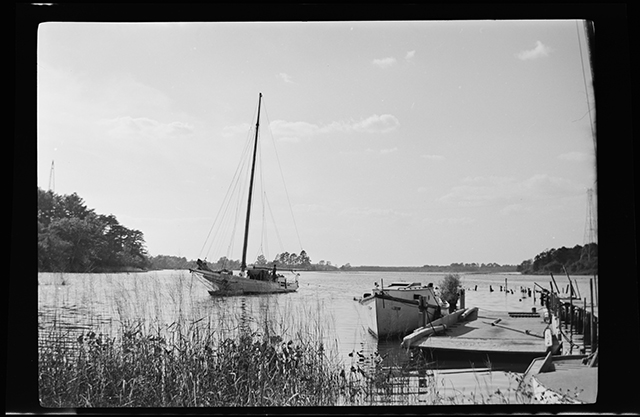 MS63-746 Skipjack Thistle
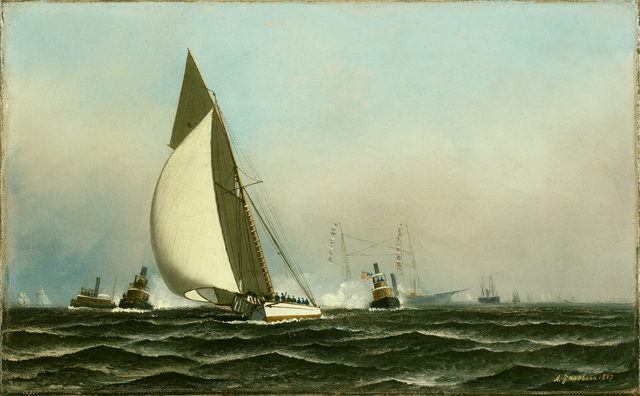 1965.0009.000001
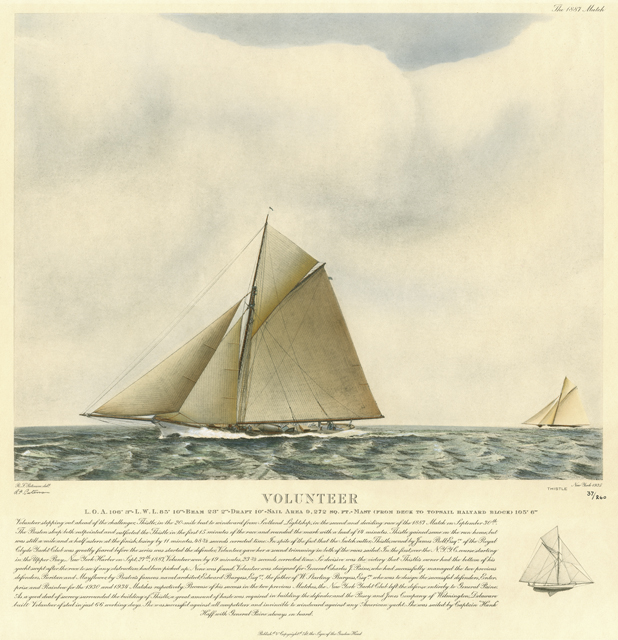 1936.0916.000001
 Full-size image
 Full-size image
 1934.0427.000001A_1
 1933.0591.000001
 Full-size image
 Full-size image
 Full-size image
 2020.0010.000001a
 MS0091-03-01-37-107
 81-40-01a
 1937.0035.000001
 MSM203 det1
 1945.0002.000041[1]
 Full-size image
 LP2110_1